Wednesday, July 25, 2012

The Beginning of ESOL B

On Saturday, July 21:
  • We walked around the city in the early afternoon, looking for food and the little shops that Karie and Terry told us set up along the river on the weekends. We couldn't find the shops.
  • Once we finally stopped for lunch, I ate a dressingless salad at Ojo al Bife. Toward the end of our meal, an entire professional soccer team filed off their bus, stopping traffic outside (which was a big deal - traffic stops for no one in Argentina) and filled up the restaurant. Then we found out that we had been locked in the restaurant once we tried to leave, and one of the waiters had to let us out. Kind of embarrassing.
  • In the evening, we went to a bar and a boliche (dance club). Might not have returned home until the wee hours of the morning. It was fantastic.
On Sunday, July 22:
  • I woke up after very little sleep and went to Mass at Nuestra Señora del Rosario, the cathedral in Rosario (fun fact: Rosario means Rosary). Because we were in a gigantic cathedral it was really hard for me to make out the words to the prayers, but it was beautiful to find the familiarity in the Mass, even though it was in a different language. The only thing that really threw me off was when the priest kissed the people that brought the gifts to the altar during the preparation of the gifts. While it is customary in Argentina to greet one another with a kiss on the cheek, I wasn't expecting to see that same gesture used in the Mass.
  • After Mass, I walked home through the parks along the river. It was sunny and beautiful and there were people everywhere. I finally had my camera with me and was able to take pictures in the parks.
  • At 7pm, I went to the Ariston Hotel for the reception for our two new ESOL B students, Jessie and Monica! It was crazy to see how tired and overwhelmed they were by everything, and how much my perspective on Argentina has changed since I was in their position only 3 short weeks ago.
On Monday, July 23:
  • ESOL B classes began. I'm only taking one class this session, which is Spanish for educators. It's already very nice to only have one class to worry about. 
  • We ate lunch at Zona with our new ESOL friends after class, and then I spent the 2.5 hours that the other students were in class uploading pictures to Facebook and killing my computer battery. 
  • When their class was done, Mary, Emily, Jessie, Monica and I went to get café con leche at our favorite cafe. When Jessie and Monica had to go back to school for their placement test, Mary, Emily and I had a great conversation about education and what this experience has done for us (so far). I love being around people who are as passionate about education and making the most of this experience as I am! The ideas we talked about will have to be summed up in another blog post.
  • I spent the evening hoping people would get on Skype so I would have something to do. Had a great conversation with Ellen :)
On Tuesday, July 24:
  • We went to a Gaucho Party! We took a bus for an hour over the Rosario-Victoria bridge and through the swampy Entre Rios province, finally arriving at the ranch. Some students rode the horses, but the horses had some attitude so I didn't ride. I enjoyed sitting in the sun and talking with the other people from the program. We ate lunch and watched a traditional gaucho dance, and the dancers were intense. Quote of the day came from Karie, who at the beginning of the show said, "I don't know what's going on, but there's going to be a fight. He has a knife." (the gaucho ended up pulling his knife and stabbing the ground with it, but then we found out it wasn't really very sharp) After the show, we ate a traditional dessert of bread pudding and scrambled eggs that were flavored with lemon and sugar. Very good, but very sweet. After dessert we went home.
  • When I got home I watched a 45 minute video of Whose Line is it Anyway bloopers on YouTube.
On Wednesday, July 25:
  • Spanish class started at 8am. I wrote a poem to express how I felt about early morning class:
This morning, I woke up before the sun.
Early mornings are no fun.
  • After class, Mary and I went to the heladeria for café con leche in the hour between when class got done and when we could eat lunch. I think Mary meant to do her homework but we ended up talking. 
  • After lunch, we went to el Pozo, which is the part of the Plaza Civica where political activists were sequestered during the Dirty War. There's no real way to describe the experience. I can't describe how it felt to stand in a room and have our tour guide tell us that in that same room 30 years ago, people were tortured through electric shocks (the use of electricity as a form of torture was invented in Argentina). I can't describe how it felt to see the detainment center in the basement, where the tour guide's own mother was held with 20 other women in 1 room, sharing 2 mattresses among themselves. I can't describe how it felt to see how close we were to the center of Rosario and to know that people outside could hear the screams of the people being tortured inside and couldn't do anything to stop it. It's a hard experience to unpack. The tour guide herself was jailed for 3 years, starting in Rosario and ending up in a concentration camp in Buenos Aires, for her involvement in a student union in high school. It was hard for me to piece together both the military history of the country and the history of the detainment center, but it was amazing to see how important this history is to the tour guide, which is why she has committed her life to educating others about what happened.
  • After our experience in el Pozo, all the ESOL B students except for Cain and me were off to their ESOL class on biliteracy. Cain, Karie and I took a tour around la Parque de la Independencia, which involved wearing just about all the clothes I brought to Rosario to keep warm, dancing to Michael Jackson's Thriller, and modeling for Karie's photos (one of which involved sitting in the same place where Ernesto Guevara's first picture was taken as a child...that seemed like a bit of a stretch of a tourist location to me).
Now that I'm only taking 1 class I have what feels like lots of free time, but with free time comes time to realize how tired I am. I have a lot more that I want to write, both for personal reflection as well as for this blog, but since I don't have Spanish until tomorrow afternoon I'm planning on getting a full night of sleep tonight so hopefully I'll feel a little better tomorrow. But I have some ideas for my next few blog posts, including mid-program reflections and truths I may have exaggerated to the other students in my study abroad program...so hopefully I'll have time to get those written in the next few days so Dan can continue to live vicariously through my blog. :)

In case you haven't seen the newest additions to my pictures, here are the links to my Facebook albums:
Bienvenidos a Rosario
Excursión a Córdoba

Saturday, July 21, 2012

16/07/12-20/07/12: A Brief Synopsis

Here is a list of my adventures from this last week:
  • We visited la Isla de los Inventos on Tuesday. It's in the old Rosario train station by the river and is filled with various learning stations where kids can engage in different hands-on activities. It was very cool because it encouraged kids to think outside of the box in order to complete the activities. It also encouraged collaboration because at many stations, you would start your own project and then leave it for someone else to finish while you finished the project someone else started. It gave us as future teachers some very good practices for culturally relevant teaching!
  • Karie and Terry threw us a pizza party Wednesday evening. It consisted of us eating pizza, telling Ella stories about what not to do in high school, playing LCR, giving Terry and Karie love notes and chocolate, and teaching the 'sorority lean.' The pictures (and Terry's captions) can be seen here: http://cultureandcommunity.weebly.com/pizza-party.html
  • I aced my Spanish final Thursday morning.
  • Thursday afternoon consisted of a trip to al Museo de la Memoria. We pass this museum every day since it sits on the opposite corner of Córdoba and Moreno from Prats. The building was one of the military headquarters during the Dirty War in late 1970's. This museum displays artistic renditions of the breaking of human rights, and it was really sad to learn more about what happened during the Dirty War and how those acts of violence were present in Rosario.
  • I stayed up late Thursday night trying to finish my Mi Aventura project, which is an ethnographic project for my Culture and Community class written in both English and Spanish. Eugenia helped edit my Spanish paragraphs (and modeled for one of my pictures).
  • I presented Mi Aventura Friday morning and got a lot of great feedback on it. I still have a little bit left to finish but it will be done soon!
  • We watched, laughed at, and quoted YouTube videos (or really just one over and over again).
  • We made empanadas, a traditional Argentine appetizer, with Annie and Emily during our Spanish class on Friday. They were delicious and super easy to make.
  • I found Starbucks! (but didn't buy anything)
  • We had a "goodbye" dinner Friday night at Cívico, a restaurant/art gallery/museum, to mark the end of ESOL A and to have an official goodbye party for Annie :( 
  • Friday was also Día del Amigo, or friendship day. Argentines celebrate this holiday by bringing their friends gifts and drinking copious amounts of alcohol until the wee hours of the morning. Since it would be super lame to spend Día del Amigo alone, all of us from ESOL A decided to take a walk to the Monumento de la Bandera after dinner. The monument was beautiful at night.
  • Eugenia was hosting Día del Amigo festivities at the apartment when I got home from the monument. It was CRAZY. And all I wanted to do was go to bed.  

Design Possible and Impossible Objects - Isla de Los Inventos
Puzzle pieces depicting the children born but not yet recovered during the Dirty War - Museo de la Memoria

Enjoying our homemade empanadas
Mastering the 'sorority lean' - I'm so proud!

Monday, July 16, 2012

Rule #5: Don't Burn Down Any Places of Historical Significance...

We had a busy weekend on our first school-planned excursion to the province of Córdoba! Friday night we were supposed to go out with Terry so we would have something to do while waiting for our bus at 3 am. We hit the town HARD - aka we all fell asleep in Karie and Terry's living room while watching Evita (a musical with Madonna and Antonio Banderas as a creepy waiter). It wasn't very good sleep since we were curled into armchairs, but it was probably better than trying to go out before our excursion. Around 2:30 am we woke up and started our trek across town to the gas station, where we met up with the students from the Language and Justice program and our guides for the weekend, Karina and Fernanda. At 3 am we all boarded the bus, which we assumed would have nice seats like the bus we took to Iguazú - no such luck. The seats were very close together, and you couldn't lay your seat back without ending up in the lap of the person behind you. Needless to say, the sleep Beba promised us didn't happen.

Around 9 am, we arrived in Villa Carlos Paz, a town in Córdoba. We ate breakfast of pasteries and café con leche, which made me slightly happier because bread is my favorite and there was chocolate on this bread and it was so good. After breakfast we had our tour of Villa Carlos Paz, which we assumed would be a walking tour like every other tour we've been on. No such luck - we were back on the crowded bus with our tour guide Mariana to tackle the 100 curves and sierras chicas (small hills) of Villa Carlos Paz. Carlos Paz is one of the most important touristic cities in Argentina because of the lake and its mild temperatures that create the ideal climate for people with health issues. We drove down by the lake and got off the bus to to look at a dam that provides most of the electricity and energy for the city. Then we were back onto the bus to drive around more, and I ended up falling asleep because I was really tired and there was a good length of time when Mariana wasn't guiding us at all. Needless to say, at this point I wasn't too thrilled by our excursion to Córdoba. We were jolted awake when Mariana told us we were entering downtown Carlos Paz, where the world's largest cuckoo clock is located. We made it to the clock right before 12, and we were ushered off the bus and ran down the street to watch the cuckoo make its appearance at the top of the hour. Unfortunately, the cuckoo was stolen last week (I remember seeing this on the news) and had just been returned, so it wasn't functioning as it should be. The whole thing was slightly anticlimactic.

On the corner by the cuckoo clock was a chocolate shop called La Quinta. They gave us a sample of alfajores, which are these delicious candies with dulce de leche in the middle, and watched them make candy in the back of the store. Then we were back on the bus, headed for lunch. We drove through what looked like a neighborhood where we stopped at what looked like a cross between a dude ranch and Bethlehem Farm. It ended up being a restaurant called Shangri-La, which had a gaucho themed interior and we got to eat carne asada - BBQ! The meat was good but very fatty, and we had oranges for dessert. I never thought I'd see the day when I looked forward to having fruit for dessert, but this fruit was long overdue and was very tasty.

My archery-pirate getup
After lunch at Shangri-La, we were off to Complejo Aerosilla, which was a park for archery and zip-lining! We had to take a chair lift to the top of the mountain to reach the park, which was really neat (I've never been on a chair lift that shows views of a city below). At the top, we were divided into two groups, and my group was off to archery first. At this point, I wasn't sure how things were going to go. I told my friends stories about how the last time I tried archery at Conner Prairie day camp, all my arrows ended on the ground about 5 feet in front of me, and I wasn't sure that I could do much better this time. After watching the group in front of me practice and seeing how their arrows actually made it to the targets by the end, I figured I could do it as well. What I didn't expect was that I would have to become a pirate in order to practice archery. If you know me at all, you probably know that I can't wink, and I look like an idiot when I try. In order to shoot a bow and arrow, you have to close one eye in order to shoot at the target. Since I couldn't wink, they gave me an eye patch to wear to keep my eye closed, which was super embarrassing. Even with the eye patch, I didn't manage to shoot my target once. I was, however, quite successful at hitting Mary's target in the lane next to me. At the end, they gave us our target sheets with our scores on it. I don't know how I managed to score a 9 - I'm pretty sure they were pity points. I threw my target sheet away so no one else would feel inferior by my awesome score. Needless to say, my dream of becoming Katniss Everdeen from The Hunger Games was officially crushed.

After archery, my group headed off to the zip-line! It was pretty fun to fly between the two mountains, and it was especially cool to see the other people who were really afraid of heights give the zip-line a go. I didn't actually make it all the way to either side: I slowed down too much (I'm still not sure how) and on the way in, had to have the guy working slide out to catch me. On the way back, I got close enough that the man let me pull myself in hand over hand, and the people who were watching said I did it like a pro :) When we finished zip-lining, we took the chair lift back down the mountain to hike el Cerro de la Cruz. What this path ended up being was a 30 minute hike up one of the mountains following the Stations of the Cross. I didn't realize that the walk was of the Stations until we started, and it ended up being a great reflection as I walked up and down the mountain. The path was all rocks and was probably one of the most realistic depictions of the Stations I've ever seen. It was an unexpected place to find God on this trip, but it was definitely appreciated and worth the trek up and down the mountain to the cross at the top.


Villa Carlos Paz from the chair lift
When we all arrived safely back at the bottom of the mountain, we checked into the hotel and freshened up for dinner. We ate dinner in the hotel's restaurant, where I was so tired that I just kept talking and talking (Mary told me I was being as open and honest as a drunk person) and I felt like a small child when Mary sent me to bed after dinner. Some of the other students wanted to hang out, but I was so tired that I fell into bed and slept very well after hardly sleeping Friday night. Sunday morning we checked out of the hotel and ate breakfast, then boarded the bus for Alta Gracia, another town in Córdoba. This town is significant because it's the town where Che Guevara moved to when he was young. We toured Estancia Jesuítica, which was a Jesuit monastery when the Jesuits originally tried to evangelize Córdoba. It was neat, but parts of the place looked like it was part of a house and I was confused because our guide could only speak Spanish and didn't take us to each room to explain what everything was. When everyone finished touring the Estancia Jesuítica, we were off to Che's childhood home. It was really cool to see the house, and a lot of the things in the house had to do with the things we saw in Diarios de Motocicleta. Seeing the things that came out of Che's involvement in the Cuban Revolution made me want to learn more about Che's involvement because the brief history we heard didn't tell me a lot since I don't know much about the Cuban Revolution. While we were touring Che's house it started hailing, and Karina and Fernanda told us that they never see hail here so everyone was getting really excited. Then we went to eat at this pizza place that kept bringing us pizzas even though we were all so full, and then we were off to our final destination of the day: the house of Manuel de Falla, a composer from Spain that died in Argentina. Basically this house was like a shrine to the man because it wasn't a house that he had built or anything - it was a house that he rented in Córdoba to help improve his health and ability to write music. One of the first things that happened when we walked in the house was that a burning log from the fireplace suddenly fell onto the floor! It was totally scary because some students were standing right in front of the fire trying to keep warm and the log fell out behind them, but the caretakers of the museum acted like it was no big deal and just threw the burning log back into the fire. We quickly left Manuel de Falla's house and were back on the road to Rosario, where I had a good conversation with Emily about the need for education and what patriotism means and explained to Emily, Annie, and Melissa what being a member of Kappa Delta is like (since they have no Greek life at Western, my experience was the only reference they had to base their knowledge of Greek life on besides what they've seen in movies, which we all know is exaggerated). Then at one point the bus pulled over to the side of the highway and jumped outside to check something, then came back in and revved the engine, then left again. We were all worried about was going on, and some students started asking who we would eat first if we were stuck on the side of the road forever. Fortunately we were able to take off and made it back to Rosario only stopping one more time, but the bus was definitely on the struggle bus.
ESOL A at the childhood home of Che
Although I was initially not thrilled by our trip to Córdoba, we ended up having a fun weekend full of meeting new friends from the Language and Justice program, unexpected Godly references, breathing in mountain air, and not sleeping. I'm still tired going into this week, which is not good since this is our last week of classes for ESOL A and I have a lot of projects to finish in a very short amount of time. I can't believe that we're almost halfway through this program, and I'm so glad that I decided to come for the full 6 week program. I can't imagine going home yet - there are so many things I still want to do here!

Friday, July 13, 2012

Thursday, Friday, and Weekend Plans

On Thursday afternoon, Cain, Mary and I went with the Language and Justice group (the other international students in Rosario through AHA) to view the Museo de Ciudad (Museum of the City). I didn't really know what we were going to get ourselves into, as Karie signed us all up to go and then left the three of us to go on our own. I walked to the park with Essence, who is the only other student from Ball State here, and we got to catch up on how our trips have been. Even though we both use the same building for our classes, we usually only wave hello in passing, so it was nice to finally talk to her about everything we've been going through here. To find the museum, we walked through Parque de la Independencia (Independence Park), which was beautiful and is definitely a place I want to visit again,. A tour guide met us outside the museum (which is in the center of the park) and showed us pictures of what the park looked like when it was first created 100ish years ago. Then we went inside and she explained the rest of the pictures and showed us a pharmacy they have preserved. The museum was neat but also a lot to take in all at once, and the tour guide told us that the point of the museum is that you will go through it once with a guide and then return to explore it on your own. I thought it was interesting that Parque de la Independencia was initially a gated park for only the elite of Rosario. When we walked through it, there were people from all walks of life enjoying the afternoon, and it was neat to compare the social and political changes of Rosario in the same physical setting.

Today we had our Culture and Community class in the morning, then went to Spanish to watch Diarios de Motocicleta (Motorcycle Diaries). This movie is about a motorcycle road trip that Ernesto Guevara (later known as Che Guevara, a revolutionary of the Cuban Revolution) and his friend Alberto Granado took in 1952 from Buenos Aires to Venezuela. Guevara was studying to be a doctor, but seeing the injustice of the world on his trip eventually led him to become a revolutionary...well I kind of extrapolated a bit based on my limited knowledge of Che's life and since the movie ends while he's still young. It was really powerful to see how much the injustice of the world affected Guevara and led him to fight actively against it, even at the age of 24. Since I don't know much about Che's activism (and apparently Che isn't a topic you should bring up in casual conversation in Argentina because people feel so strongly about him and his actions) the movie didn't change my views of him politically, but I thought it provided a neat anecdote for how pushing yourself outside of your comfort zone helps you to see the world differently and change your actions to reflect your newfound awareness. Maybe I picked this out because I feel like I'm currently having that kind of experience myself, but I really liked the movie and its message (Padre, I fully expect that you will go look this movie up on Netflix now).

This weekend, we're going on our first school-planned excursion to the province of Córdoba, which is the province to the west of Santa Fe and home to the second largest city in Argentina. I don't believe we're actually going to the city, but we're going to tour Che's home and go trekking (I'm pretty sure Beba told us there's a zip line and I'm super excited). It wouldn't be a real adventure if there wasn't something sketch involved, so we're leaving from a GAS STATION at 3 in the MORNING (this is a SCHOOL-ORGANIZED excursion, let's not forget). So that we don't all have to walk across the city alone at 3 am, Terry and Karie are hosting a movie night for all of us, followed by (as Karie put it) bar-hopping with "Terry [who is] committed to hitting the town." Terry and Ella aren't going on this excursion with us, so Karie is sending Terry out with us so that she can sleep before our bus ride. The rest of us will just have to sleep on our significantly-shorter-than-any-bus-ride-to-an-excursion-that-I've-been-on-in-Argentina bus ride, which is what Beba initially recommended for us all to do (it's not like she knows we're a bunch of college students or something). I'll let you know when we get back how our excursion to Córdoba was (and which boots Terry decided to wear tonight). Next week will be a little busy since it's our last week of classes for ESOL A (I can't believe how quickly this program has flown by!) but I'm already looking forward to having a low-key weekend in Rosario while we wait for ESOL B to start.

Wednesday, July 11, 2012

The Beauty of the City

The last couple of days have been filled with some unexpected surprises. Yesterday's classes were pretty low-key. We were in the middle of Spanish class when the power went out in the Fundación Prats, and the caretaker Sylvia (I think that's her name) ran in and opened the windows so we could continue with class. Turns out, the power outage was city-wide, but they had power back up and running within a half an hour. We also had an interesting conversation about our barrios (neighborhoods). I said that I needed to explore my barrio more, and my Spanish teacher Sole told me that I live in a good location - very close to both the river and the center of the city. When classes finished at 4, I felt inspired by our discussion about my barrio and decided that I would go on a walk to find the river. I also felt like I needed to get some exercise, since Eugenia keeps telling me that she is going to make me fat by the time I leave (which is not going to happen).

The last few days have been very cold in Rosario, so I put on my layers of clothing and walked the 5 blocks to the river.  The street I walked down opened to the Parque de las Colectividades, which was very open and green but covered in graffiti. I started walking to the right because I knew there were more parks to walk through, and I wanted to find the Monumento de la Bandera (Monument of the Flag) which is a tall structure that is lit up with the colors of the Argentinian flag at night. I walked through the first park and past some restaurants along the river bank, past an indoor bike track and came up on a gigantic set of stairs, which marked the entrance into the Parque de España. There was a HUGE skate park there, and there were people everywhere - riding bikes, skateboarding, practicing tricks on roller skates - and it was neat to watch them display their talents through that medium. At that point, I wasn't sure how much further I should walk, but I could see what I thought was the Monumento de la Bandera not too far ahead of me and I decided to see if I could get there. As I got closer, it was starting to get darker, and when I finally reached the Monumento, the lights turned on and it started to glow a light blue. On my way back, there was a park with a swing set that gave me a clear view of the Monumento, and I was overcome with the desire to swing. I got a few stares from the weird people sitting in the park, but it gave me both such a rush and such a feeling of peace to be swinging, watching the Monumento light up in front of me. After a few minutes of swinging, I walked back through the parks through which I had come and got to see the city unfold in front of me. Before living in Rosario, I don't think I would have called an urban city 'beautiful,' but seeing the tall apartment buildings lining the avenue on my left and seeing the parks and river to my right made me begin to appreciate this urban beauty as well. And now I've found a great place where I can go run and work out and not worry about getting fat, so I know I'll definitely be going back and will be able to take pictures.

When I got back home, I figured I was in for the night, so I settled on the couch in my mismatched workout clothes to read for Culture and Community. Around that time, Eugenia got home from work and got dressed up. She had told me on Monday night that she was going to eat dinner with a friend Tuesday night, but I didn't understand that I was going to dinner with her! I quickly threw my nicer clothes back on and we walked down the street to Norma's. I had met Norma on my first day here, as she picked me up with Eugenia from the hotel and drove us home. I didn't know she had an 18-year-old daughter, Julieta, so Eugenia introduced me as soon as we arrived at the apartment. Julieta told me that I could speak to her in English if I wanted to (I must have really been struggling) but I told her that I wanted to practice my Spanish so that I would get better at speaking. Eugenia has been telling me that my Spanish has definitely improved since I've been here, and that I'm able to understand everything she says (kind of not really true) and that I write perfectly (I know I definitely write better than I speak). While Julieta was very patient with me and spoke slowly, she spoke so quietly that I still had a hard time understanding what she was asking me! Then during dinner, Eugenia and Norma got into a heated discussion so they spoke even quieter and faster, and I might have completely zoned out because I was so tired and overwhelmed. I gave Julieta my phone number because I guess she's at home during the afternoons when I get home from school and Eugenia wants us to hang out so that we don't have to be alone. I'm excited to hopefully hang out with her again because talking with her is only going to help improve my ability to comprehend Spanish. I think I was just caught a little off-guard going over to Norma's last night that I wasn't able to comprehend at my highest ability.

This morning, the ESOL group had to get up early to go observe at our second school, Colegio Mariano Moreno N°60. This was a public school, meaning it is free for students to attend, and we could sense the differences as soon as we walked in the door. The principal greeted us and asked what activities we had planned to do with the children. We told her we were just there to observe, and half the group went to observe a class of little kids and the rest of us were off to observe the middle school students. The principal didn't have a classroom of older students set up for us to observe in, so she just barged into a couple of classrooms to ask if we could observe, completely interrupting the teaching going on. We were placed in a social studies classroom, where it seemed that only some of the students were paying attention to the reading from the textbook. After a short time, the bell rang for recess, and we followed the students outside. We were swarmed by students that asked us really random questions. A group of girls asked if I was on Facebook, and then asked what my last name was so we could be Facebook friends. Fortunately, I was saved by the bell (literally), because I didn't want to give them my name and I didn't know what to tell the girls! We weren't sure if we were supposed to go back to the classroom we had been in, so Terry asked the students who their favorite teacher was and they pointed to a man who was walking around with a guitar in hand. So we followed a different group of students to music class, where most of the class didn't even try and engage in the exercises the teacher led them in. I recognized a lot of the exercises from my music classes, and it was neat for me to see that music really is a universal language. Then he asked us to sing a song, and we had no clue what we were supposed to do. Cain, Annie and Ella ended up singing a camp song about a donut that I didn't know, and the students just looked so confused. When they finished singing, Terry thought we were supposed to be back downstairs, so we left the class and waited downstairs for the rest of our group to show up. The principal came out of her office and asked if we wanted to see one other group, and she took us to a 4th grade classroom. The teacher would give each student a subject and verb tense, and the student would have to conjugate the verb to match the given parameters. I understood what was going on, even though it was all in Spanish, but if I was one of those students I would have been so intimidated by her teaching style! We left class about halfway through and went to a café as a group to debrief our experience in this school. As we walked back to the Site, I talked with Karie about bilingual education and why it isn't more widely supported. We don't have a bilingual teaching license program at Ball State, but I really wish we did - from my understanding, there are so many benefits to that kind of teaching style that most importantly allow students to maintain their first language while learning English.

After our Spanish class in the afternoon, the ESOL group had a movie night at the Site. We watched Cautiva, an Argentinian film about a girl who discovered that she had been living under a false identity for year and that her parents "disappeared" during the Dirty War. Have you ever heard of the Dirty War? I hadn't until this movie, but it happened in the late 1970s and had to do with the military regime making those people politically involved with the communists "disappear" into concentration camps. It's definitely a topic that I plan to study more while I'm here. Although the story in Cautiva was fictional, it was really sad to see how the events of the Dirty War still impact Argentina.

On that note, I'm going to bed, since I'm still wiped out from Iguazú and waking up at 7:30 every morning is a challenge! I'm not sure why I chose teaching as my future profession since I'm definitely not a morning princess...

Monday, July 9, 2012

Las Cataracas del Iguazú

This weekend, I did the one thing I didn't want to do while I was abroad: travel without a planned excursion. We had a three-day weekend in order to celebrate Argentina's Independence Day, and my friends decided that they wanted to celebrate by traveling to Las Cataracas del Iguazú, one of the seven natural wonders of the world. I was a little apprehensive about going at first, since this was only my first weekend in Argentina, I was still catching up on sleep from arriving, and it would just be 5 of us students going. After some convincing, I figured I probably won't have the opportunity to go to Iguazú again and I decided I was all in. We boarded our bus to Iguazú at 6:30 pm Friday night, and we didn't get off the bus until 2 pm Saturday afternoon. The trip wasn't unbearable because I was able to sleep a lot and I had 4 poorly made films with Spanish subtitles to watch for entertainment.

Once we arrived in Puerto Iguazú, we tried to find our hostel. We had tried to make a reservation online before we left Rosario, but the hostel hadn't received our reservation and they told us that we would have to come back to see if they had a room available. The whole thing seemed a little sketch, so we kept walking around the town to find a hostel. We found one and dropped off our things, then decided to explore the town. Puerto Iguazú is completely different from Rosario. It's in the province Misiones, which is one of the poorest provinces in Argentina, and makes its livelihood on tourism. While Rosario has a European vibe, Puerto Iguazú felt very Latin American. We explored the city and went into many little touristy shops that all basically sold the same things. After shopping for most of the afternoon, we found a restaurant for dinner and then decided that we should go to bed in order to spend as much time on Sunday as possible at the Falls.

On Sunday morning, we made it to the bus station around 10 am, carting all of our things. The bus ran to the Falls about every 20 minutes, and soon we were crowded onto the bus, on our way to one of the 7 natural wonders of the world!

Once we arrived at the park, we found out that it cost 130 pesos to enter, and they didn't accept credit cards (seriously, what national place doesn't accept credit cards?). I didn't have enough pesos on me, so Emily had to help cover my entrance fee. We entered the park and found a place to meet in case we got separated, and then Emily, Melissa, and I were ditched by Cain and Annie (rude). We asked for a map of the park and started walking along the green path that would take us to the Falls. The paths weren't labeled very clearly, which made it hard for us to find where to go. After walking the wrong way initially, we found our way to the Lower Path, and we decided to walk along and see where we ended up.


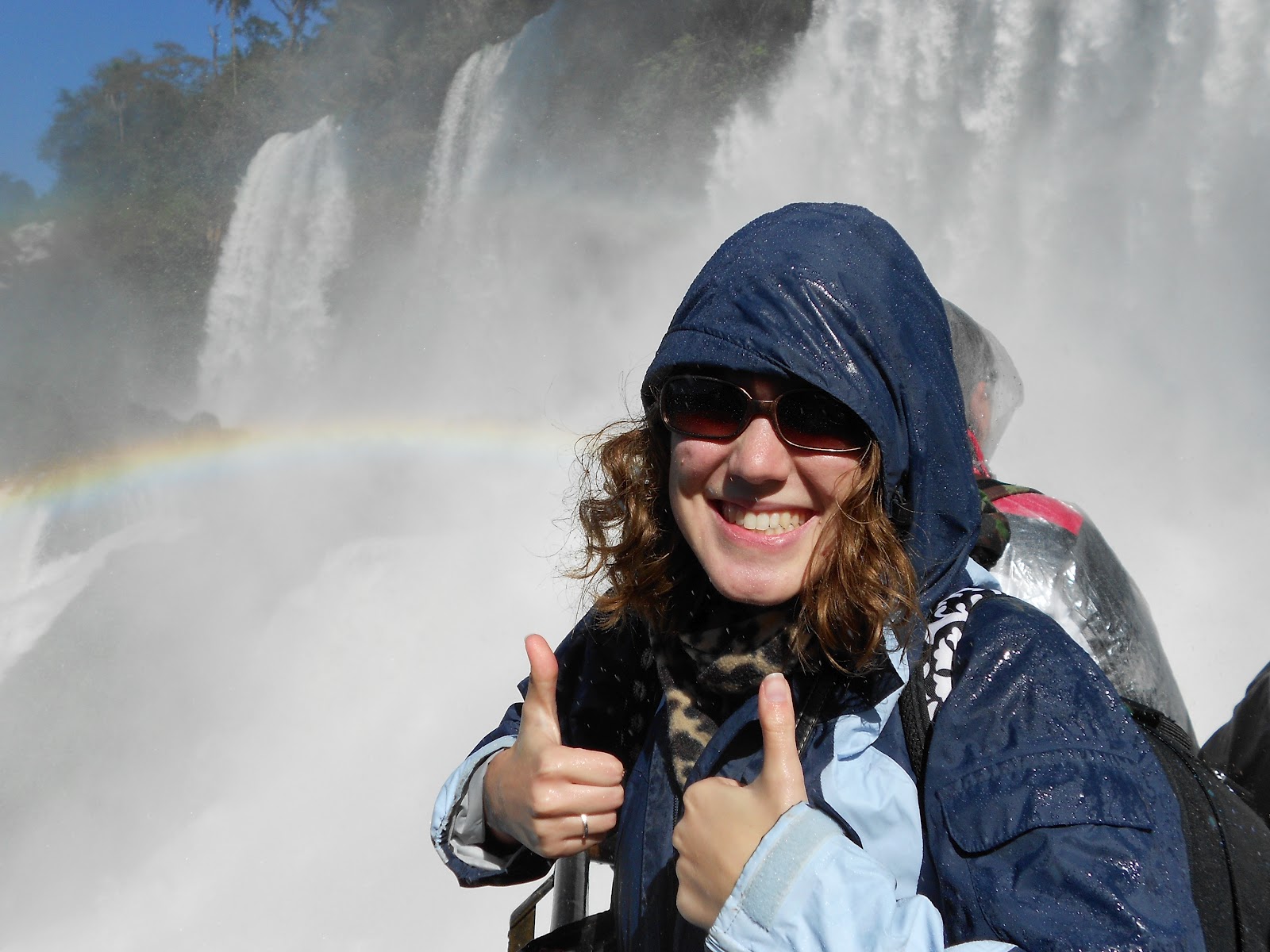
We passed some wild animals and a small waterfall - Salto Alvar Nuñez. After turning some corners, we finally emerged on the most gorgeous place I've ever seen. There were rainbows EVERYWHERE and the Falls spread as far across as I could see - cheesy description, but true! We kept walking along the lower path and reached the place where we were standing right under the Salto Bossetti! The path was slippery and very crowded, and we were soaked by the end, but the view was worth it.

Our next visit was to the upper path, which took us to the top the Salto Bossetti. The view was still cool, just very different. At the end of the upper path, we looked at the map to see where else we could go. Originally, we wanted to either take a boat ride right up to the Falls or walk around on La Isla de San Martin in the middle, but a boat ride would be cold and the island was closed due to high waters in the river. Instead, we hopped on the train and rode out to the Estación de la Garganta del Diablo to see the last of the Falls.

We had to walk a ways over the Río Iguazú Superior to reach the Garganta del Diablo (Throat of the Devil), and we were able to see the spray from the falls rebounding and filling the sky around the Falls from a ways out. When we reached the Falls, we were standing right over the top of the Falls, and you couldn't even see the bottom of the Falls because of the spray! The view was fantastic, and I can't even explain to give it justice so this video will have to suffice:


At that point, since we had seen everything, I became a little grumpy from carrying my heavy backpack and Vera around all day and not having eaten anything since breakfast. Emily, Melissa and I took the train back to the station in the middle of the park, where we were able to meet Cain and Annie at 5 and take the bus back to Puerto Iguazú. When we arrived, we had about 3 hours before our bus was supposed to leave for Rosario, so we ate dinner and walked around, looking at some of the stands where people sold their handmade goods. We were all looking forward to the bus ride home because we had nicer seats and thought we would be able to sleep well (and were hoping for some better movies, and we were not disappointed although I couldn't hear the movies from my seat - they showed The Girl with the Dragon Tattoo and One Day, both movies that I wanted to see). The ride back to Rosario took about 20 hours, and it felt so good to walk the 18ish blocks back to my house when we arrived.

So that was my weekend! I had fun bonding with the others who went, seeing one of the natural wonders of the world, and navigating some of the sketchy places of Puerto Iguazú. After 20 hours on the bus I'm tired and a little smelly, but the sights we saw at Las Cataracas definitely made the trip (and all the minor inconveniences that came with it) worth it.

Here's the link to see the rest of my pictures from Iguazú:

Friday, July 6, 2012

El Colegio Español

I got to Skype with my family last night! It was wonderful but they told me I looked a little tired so when we ended the call I just went to bed...I mean, even abroad, I have to follow my bedtime (jokes jokes jokes. Everyone knows I don't sleep!)

Yesterday, the ESOL group arrived at the site early to visit the Colegio Español in Rosario. This trip was important because the Colegio Español is a private school, and all public schools in Argentina are FREE for students to attend. This is the standard for all the public schools, from preschool to the university level. We'll visit a public school in the next week or two, and it will be interesting to compare the schools. I wasn't really sure what we were going to see when we got the school, but we took the bus across town and arrived. A woman named Celia met us in the front office, and she spoke impeccable English. She told us we were going to sit in on the 7th grade English language classes, which is just like how students in America take classes on the Spanish or German or Japanese languages. We took a tour of the school building and learned about the influences that Spain has on the school. The uniforms the students wear sport both the flags of Argentina and Spain, Spain's National Anthem plays at school assemblies, and there is a replica of the boat that came from Spain to Argentina. I didn't fully understand why Spain was so important to this school, but you could see its influences everywhere.

Once we finished the tour and had a coffee break in the staff room, we were divided into pairs to go observe the 7th grade English classes. Celia warned us that the students would be very interested in talking to us and asking us questions, but because of their knowledge of the language, their questions might come across as inappropriate. Emily and I were lucky that the students in the classroom we visited were very inquisitive, but also very respectful. There were only 12 students in the entire class, which gave every student ample opportunity to participate in class. The class was studying directions, and I remembered all of the Spanish classes I've taken that have used almost the exact same material. What was interesting about these students, however, was how incredible their English was. As 7th graders, their entire class took place in English! We found out that these students had been taking English classes for 40 minutes a day, 5 days a week, since they were in Kindergarten! They've been taking English for about as long as I've been taking Spanish classes, but I felt like they could speak much better than I am able to at this level. The English they were learning was very formal - it sounded like they were trying to speak with British accents, and they learned to "turn into the street," not to "turn onto the street" like we would say. On the other hand, I'm sure that the Spanish we learn to speak in the United States is very formal as well.

Observing this class made the possibility of teaching English abroad seem very appealing and very achievable. I'm not sure whether it's something I'm really interested in pursuing long-term, but it's another option for teaching that I think I'll file away and continue to reflect on. I think all of us were impressed with the quality of the school, so it will be very interesting to see how the English classes in the public school are different and if that will change my mind about possibly wanting to teach abroad.